WAIVES: learning stochastic dynamics from one noisy trajectory
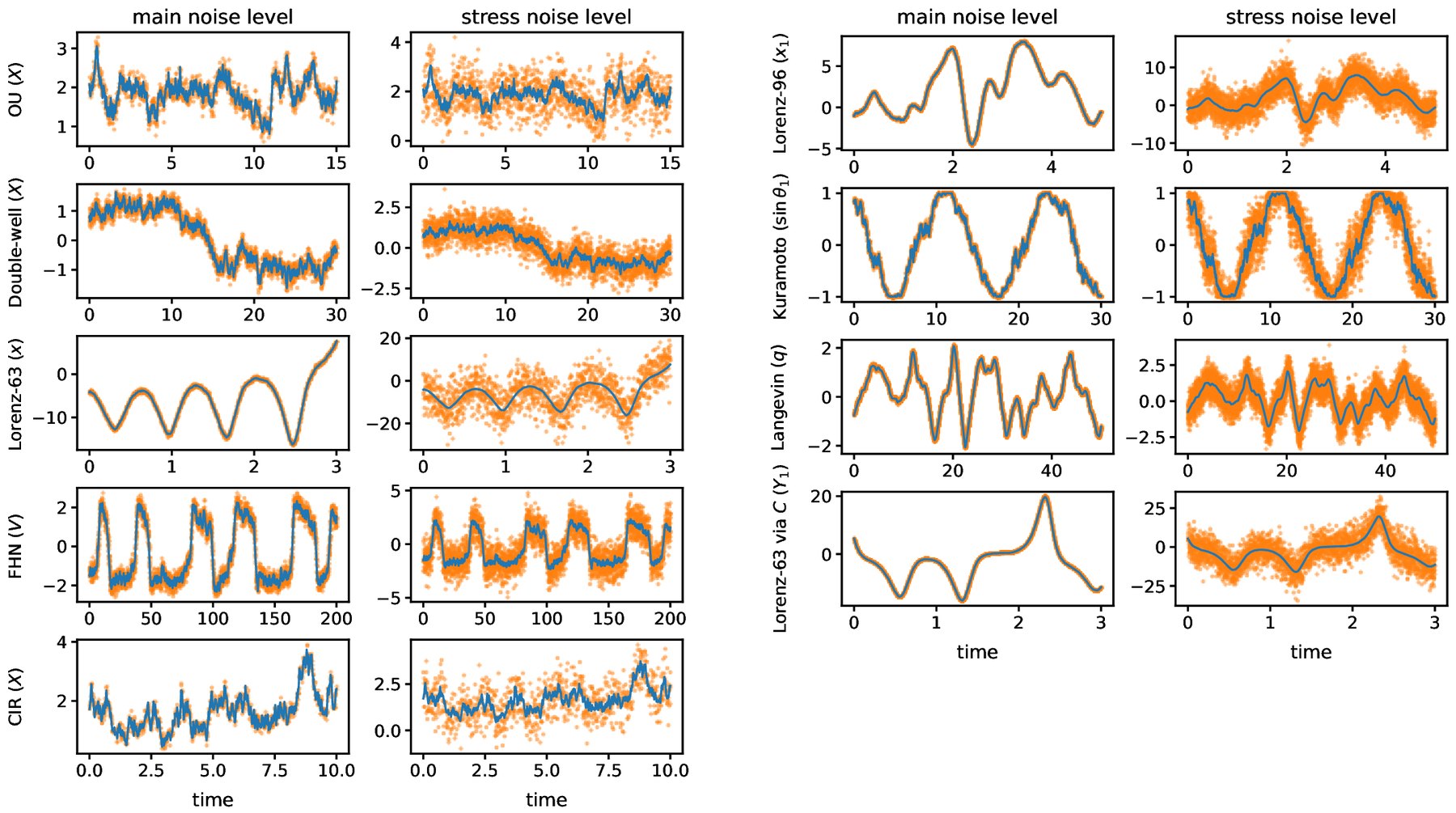
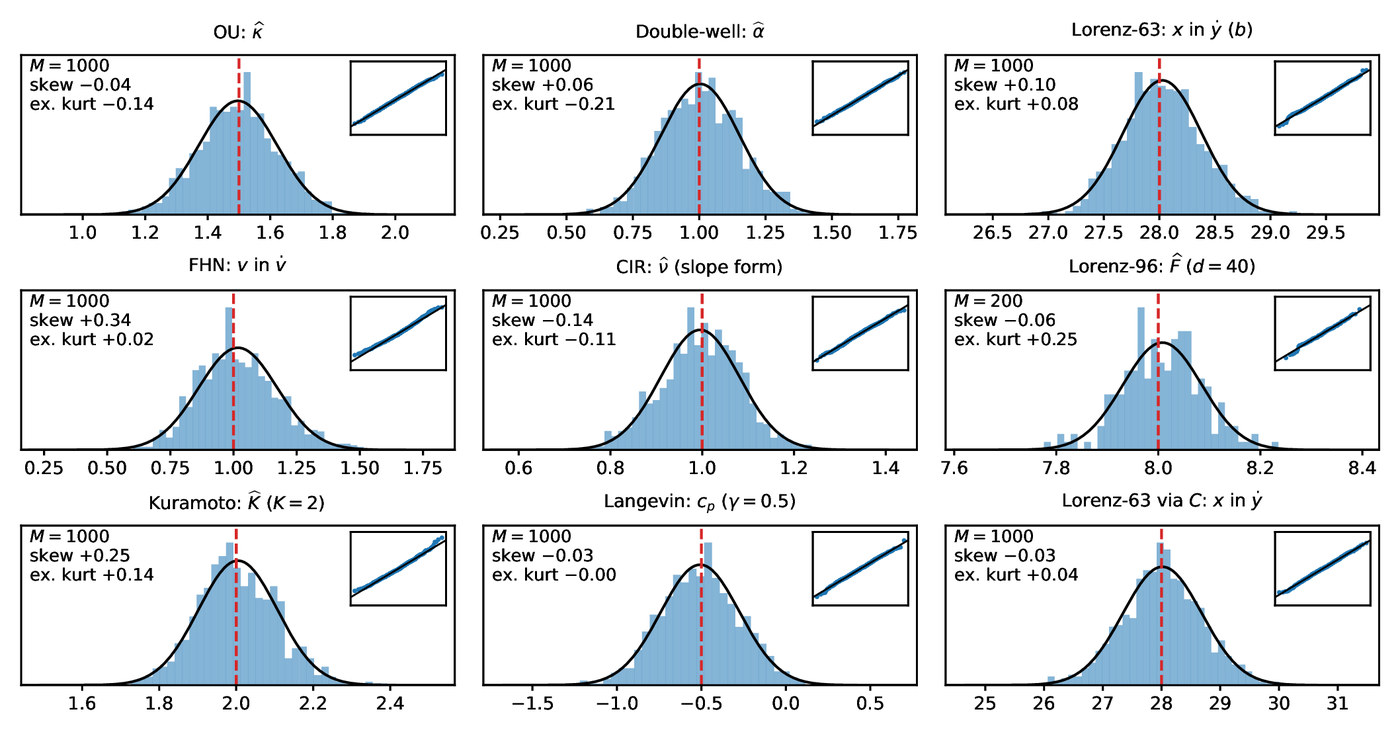
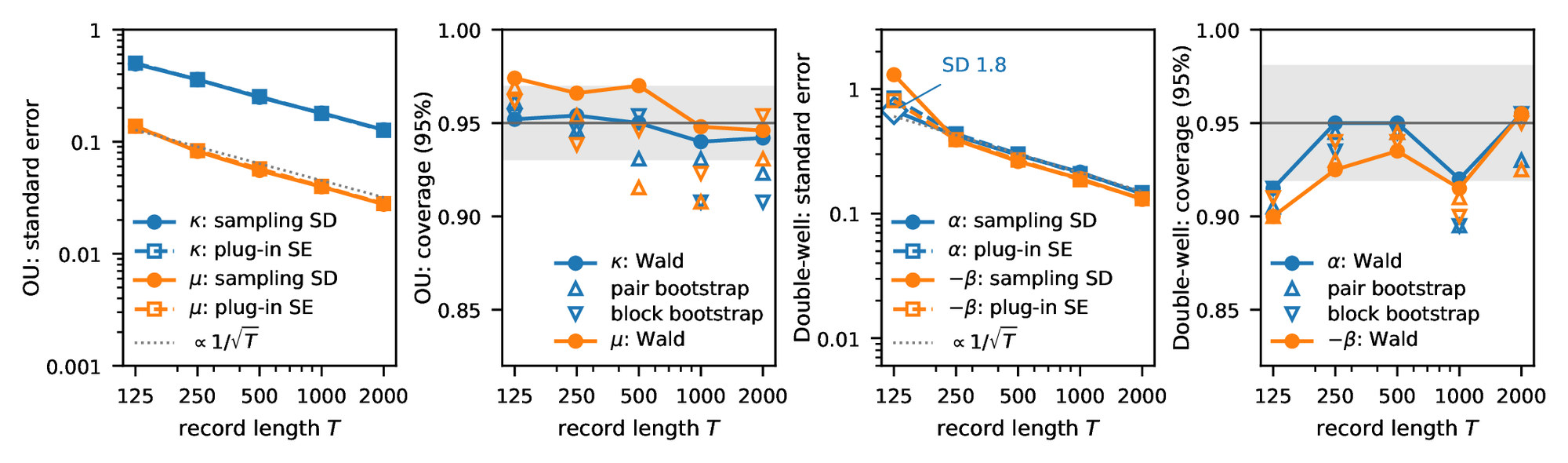
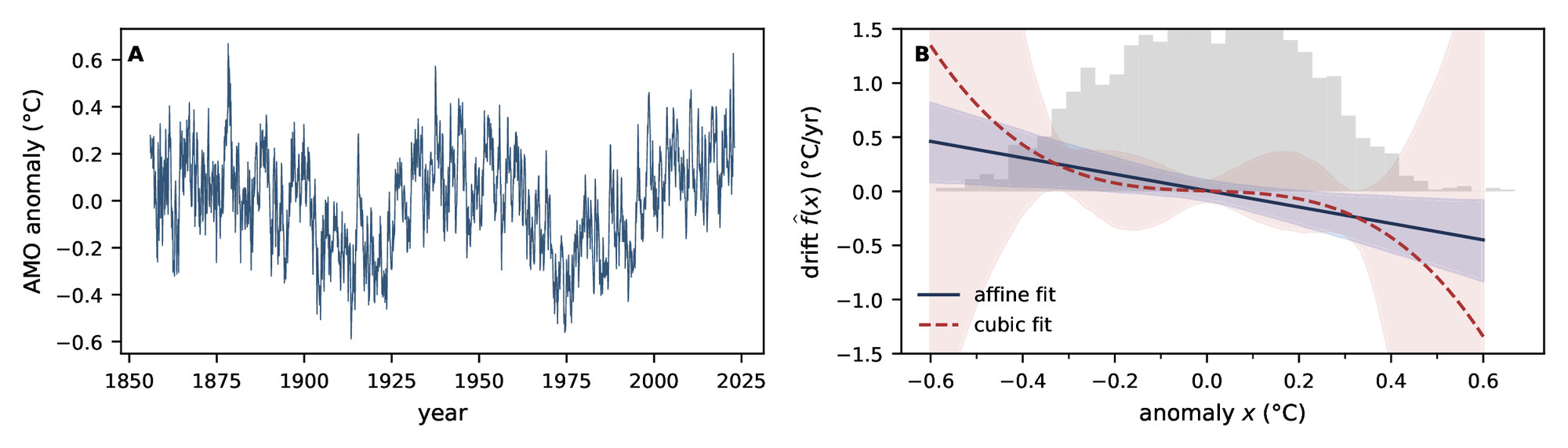
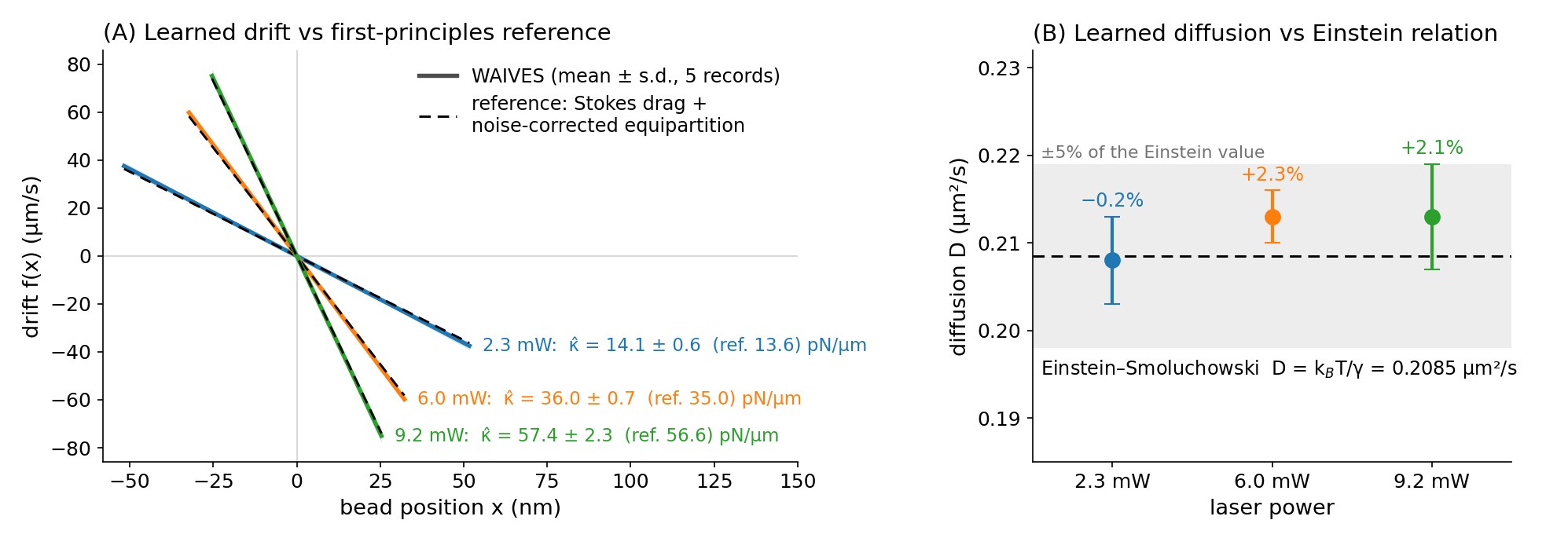
Weak-form methods made inference for ODEs fast and robust to noise by integrating the equations against smooth test functions instead of differentiating noisy data. WAIVES brings this idea to stochastic differential equations. From a single trajectory, sampled at discrete times and observed with noise, it recovers the nonlinear drift and the diffusion with one linear solve, with no likelihood, filtering or simulation, and it returns standard errors and calibrated confidence intervals.
The weak form
Multiply the SDE by a smooth test function supported on a short time window and integrate by parts. Derivatives fall on the known test function rather than on the noisy data, and each window gives one row of a linear regression for the drift parameters.
The trap: endogeneity
The regression error is a stochastic integral over the window, built from the same Brownian increments as the regressors. Weak-form ordinary least squares, with no instruments, is therefore biased and inconsistent: for any time-reversible diffusion, including every stationary scalar one, it converges to zero drift however long the record.
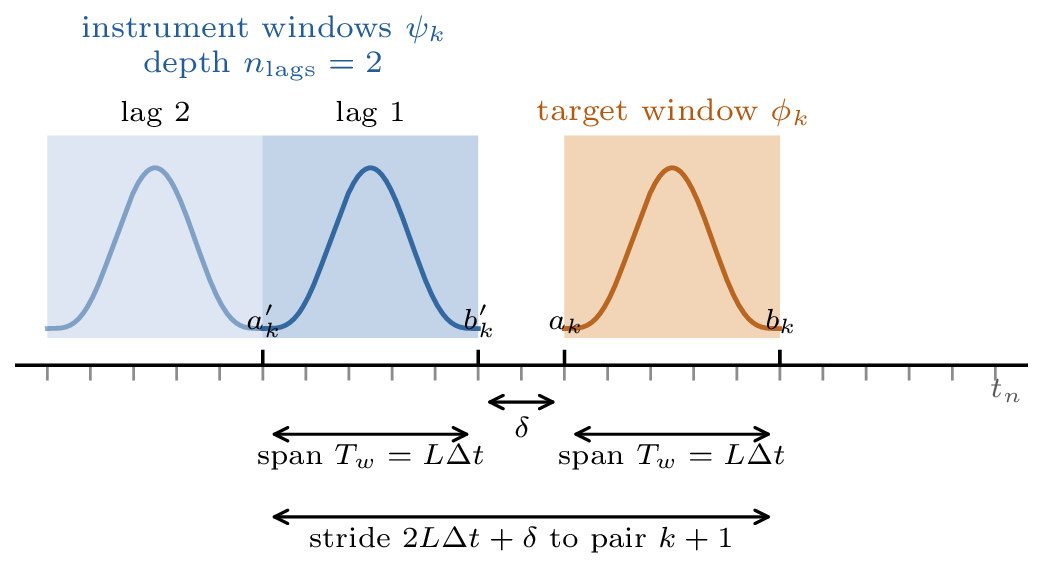
The fix: instruments from disjoint windows
Instrumental variables, a classical tool from econometrics. Weak-form integrals over a nearby, earlier, disjoint window are correlated with the regressors, because the process remembers, but independent of the error, because Brownian increments over disjoint intervals are independent. The resulting estimator is consistent and asymptotically normal, and it separates measurement noise from the randomness of the dynamics.